SPECIALIZED INTEGRATED MANUFACTURER

Buying aluminum casseroles in bulk isn’t just about driving down the unit price. You really gotta think about what you’re actually gonna use them for—how much they serve, the kind of cooking environment you're dealing with, and how you’ll store them. For example, a restaurant probably needs casseroles with thick walls and secure lids that can handle constant use, while a catering company might prefer lighter, stackable options. If you're selling to households, the look of the finish, consistent packaging, and reliable restocking are usually key. Little details matter a lot—like a loose lid that could mess up the boxes during shipping or uneven rims that might cause customer complaints. That’s why choosing the right one isn’t just about price.
In this guide, I’ve put together ten handy tips to help you evaluate suppliers—covering materials, dimensions, finishes, quantities, delivery terms, and more. Smart buyers often ask for samples before placing big orders—they check the base, handles, how well the lid fits, surface quality, and how easy it is to clean. Plus, communication with your supplier really matters—clear specs, inspection reports, and proper food-contact certificates can save you a lot of headaches down the line. A good manufacturer should explain their alloy choices, tolerances, packaging methods, and quality control measures—no vague promises allowed. Sure, price is important, but the cheapest quote might hide thinner materials or inconsistent sizing that could lead to costly replacements later.
No checklist is foolproof, and buying usually involves some compromises. For example, a thicker aluminum casserole might last longer but could be heavier and cost more to ship. An eye-catching finish might attract more customers but needs better packaging to prevent damage. Seasonal demand can also affect how much you should order. It’s best to review all these factors with an experienced procurement expert—they can help make your process more reliable. Keeping good records, setting realistic delivery expectations, and having honest chats with suppliers really help build a solid, long-term relationship. And hey, mistakes happen—that’s just part of the process. But taking time to reflect on what went wrong helps keep small errors from turning into big problems.
Before requesting quotations, define how the casserole will be used. Record serving capacity, diameter, depth, lid style, and expected daily volume. A 1.5-liter dish suits individual portions, while a 5-liter model supports shared service. Measure storage shelves and oven clearances, not only the product catalogue.
Treat Casserole Aluminum as a specification, not a generic product name. Ask for alloy information, material thickness, handle construction, surface finish, and temperature limits. Confirm whether the vessel works with gas, electric, induction, or oven heating. Induction compatibility may require a magnetic base. It is easy to overlook this detail. The International Aluminium Institute reports that nearly 75% of all aluminium ever produced remains in use, showing the value of durable material planning. Still, durability depends on gauge and workmanship, not aluminium alone. Request samples before approving a bulk order. Test stacking, lid fit, heat distribution, cleaning time, and resistance to warping. Measure one sample after repeated heating. Imperfect records can distort your cost estimate. Include cartons, pallets, freight, storage, replacements, and import duties in the landed-cost calculation. For food-contact use, request current compliance documents and traceability records for every production batch. Set acceptable tolerances in writing, especially for diameter, capacity, and wall thickness. A cheaper unit may become expensive when lids loosen or nesting fails.
Use the comparison below to clarify the key specifications before requesting bulk quotations. Larger quantities may reduce unit cost, but capacity, thickness, lid requirements, and delivery time should be confirmed first.
Planning reference: compare four common bulk-order quantities against the estimated purchasing priority score for each requirement. Scores use a 1–10 scale, where 10 indicates the requirement should receive the greatest attention during supplier evaluation.
Buying an Aluminum Low Casserole in bulk starts with the alloy, not the discount. For everyday braising, 3003 or 3004 aluminum offers practical corrosion resistance and strong heat transfer. A 5052 body suits heavier commercial handling, but it may cost more. The ASM Handbook lists thermal conductivity near 193 W/m·K for 3003 aluminum and about 138 W/m·K for 5052. That difference can affect heating speed and hot spots.
Size and shape must match real kitchen routines. A 2–3 liter round casserole works for sauces and small portions. A 6–10 liter rectangular pan fits batch roasting and shallow storage. Check the base diameter against the burner, especially with an Aluminum Low Casserole. A wide, low profile evaporates moisture faster. Deep walls reduce splashing. Measure usable capacity, not the rim-to-rim volume.
Features deserve physical testing. Compare rolled edges, lid fit, handle clearance, and surface treatment. Anodized aluminum can improve scratch resistance, yet it does not make careless stacking harmless. I would not assume thicker always means better; excess weight raises shipping and handling costs. The International Aluminium Institute reports that recycled aluminum requires about 95% less energy than primary metal. Ask suppliers for alloy certificates, coating details, and recycled-content evidence. USGS estimated global primary aluminum production at roughly 72 million metric tons in 2024, so supply volume is large, but quality consistency still needs sampling. One carton can hide uneven bottoms.
| Tip | Buying Dimension | Useful Comparison | Recommended Bulk Specification | What to Verify Before Ordering |
|---|---|---|---|---|
| 1 | Choose the aluminum grade |
1100: highly formable and corrosion-resistant, but relatively soft. 3003: aluminum-manganese alloy with better strength than 1100 and commonly suited to formed cookware. 5052: magnesium alloy with good corrosion resistance and higher strength, but it may require more forming force. |
Use 3003 for a practical balance of formability and strength; consider 1100 for lightweight, easy-forming products and 5052 where additional strength is important. | Request the alloy designation, temper condition, material certificate, and food-contact compliance documents for the intended market. |
| 2 | Match thickness to use | Thin aluminum heats quickly and reduces shipping weight; thicker walls and bases resist denting and temperature distortion better. |
0.8–1.0 mm: lightweight serving or disposable-style use. 1.2–2.0 mm: general-purpose reusable casserole use. 2.0–3.0 mm: heavier-duty cooking and commercial handling. |
Confirm whether the stated thickness refers to the sidewall, base, or the minimum measured point. |
| 3 | Select the right capacity | Capacity affects portion size, stacking efficiency, storage space, and shipping volume. |
1–1.5 L: side dishes or individual portions. 2–3 L: meals for approximately 2–4 people. 4–6 L: family-size casseroles or larger shared portions. 9–11 L: foodservice and batch preparation. |
Ask for both brim-full capacity and recommended working capacity; usable capacity is normally lower to allow room for stirring and expansion. |
| 4 | Compare shapes | Round pans promote even stirring; rectangular pans use oven and storage space efficiently; oval pans provide a longer cooking surface. |
Round: approximately 20–28 cm diameter. Rectangular: approximately 28 × 18 cm to 40 × 30 cm. Oval: approximately 30–38 cm long for roasts and elongated dishes. |
Check internal dimensions, external dimensions, corner radius, lid fit, and whether dimensions include handles or rims. |
| 5 | Confirm cooking-surface compatibility | Bare aluminum conducts heat well but is not naturally compatible with induction cooktops, which require a magnetic base. | For gas and conventional electric cooking, standard aluminum may be suitable. For induction, specify a bonded magnetic stainless-steel base or another induction-compatible construction. | Require written compatibility details and test samples on the exact cooktop types used by customers. |
| 6 | Evaluate the surface finish | Polished surfaces are easy to inspect; brushed finishes can hide minor marks; anodized surfaces are harder and more wear-resistant than untreated aluminum. | Choose untreated aluminum for cost-sensitive applications, hard-anodized aluminum for improved surface durability, or a suitable coating where non-stick performance is required. | Check coating thickness, adhesion, abrasion resistance, maximum temperature, and permitted utensils. |
| 7 | Decide on lid and handle features | Lids reduce moisture loss and help retain heat; handles improve transport but increase packed dimensions and may become hot during cooking. | For catering, consider stackable lids and riveted or welded side handles. For oven-to-table use, specify heat-resistant handles and a secure lid design. | Verify handle load strength, attachment method, lid venting, lid interchangeability, and heat-resistance instructions. |
| 8 | Check oven and dishwasher requirements | Bare aluminum is generally oven-suitable within the specified temperature range, but coatings, plastic components, and some lids may have lower limits. | Specify the maximum oven temperature, whether preheating is allowed, and whether the complete set or only the pan is dishwasher-safe. | Request temperature testing, care instructions, and confirmation that repeated washing will not cause excessive discoloration or coating damage. |
| 9 | Prioritize stacking and logistics | Nestable shapes reduce carton volume, while lids, handles, and flared rims can increase the required packing space. | For bulk orders, compare nested height, units per carton, carton dimensions, gross weight, pallet quantity, and estimated shipping volume. | Obtain a packing diagram and calculate landed cost per usable unit rather than comparing product price alone. |
| 10 | Set quality and inspection criteria | Bulk consistency matters as much as individual performance. Dimensional variation, sharp edges, coating defects, and unstable bases can create higher return rates. | Define acceptable tolerances for diameter or length, height, thickness, weight, flatness, surface finish, handle strength, and lid fit. | Use a pre-production sample, approved reference sample, batch inspection plan, and documented acceptance limits before mass production. |
When buying an Aluminum Casserole Pan in bulk, inspect more than its appearance. I once received pans with smooth surfaces but uneven bases. They rocked on flat counters. Request production samples before placing a large order. Check wall thickness, weight consistency, rim finishing, and handle attachment. Small dents often reveal weak packaging or poor forming control.
Tip: Ask for food-contact safety documentation, alloy information, and recent laboratory test reports. Confirm that coatings resist peeling, flaking, and staining during repeated use. Examine each sample under bright light. Look for sharp edges, pinholes, discoloration, or exposed metal. Safety claims should be traceable to recognized testing procedures, not vague promises. Keep the documents with your purchasing records.
Durability also depends on practical design. Fill a sample pan with water and lift it by the handles. The body should remain stable without bending. Test stacking, lid fit, oven movement, and cleaning cycles. My mistake was judging durability after one week; commercial kitchens create harsher conditions. Ask about heat limits, dishwasher resistance, and storage instructions. Compare ten random units from a shipment, not only the best sample. Record defects with photographs, batch numbers, and delivery dates. A clear inspection plan protects quality, although it may slow purchasing decisions. That delay is sometimes worthwhile.
Buying aluminum casserole in bulk starts with supplier credentials. Ask for business registration, factory address, product certificates, and recent audit records. A reliable supplier should explain alloy grade, wall thickness, coating, handles, and heat limits clearly. Request production photos and a video call from the facility. Check export experience with similar cookware. Do not accept polished claims alone. Call two former customers, if they agree to be contacted. This small step often exposes missed delivery promises.
Compare landed pricing, not only unit quotes. Ask for tooling, packaging, inspection, freight, and payment charges separately. Confirm currency and quote validity in writing. A low price can hide thin walls or unstable coating. Request the minimum order for each size, lid option, and carton design. Negotiate a mixed-size order only when packing quantities are confirmed. Ask about price breaks at 500, 1,000, and 5,000 units. Keep a contingency budget. Freight can change.
Order samples from the same production line planned for bulk manufacturing. Test weight, flatness, lid fit, rivets, handle temperature, and cleaning resistance. Use a kitchen scale, not your hand. Record defects with dated photos. One sample is rarely enough. Ask for three pieces from separate batches when possible. Review labels and instructions for accuracy. I once overlooked carton compression, and several units arrived scratched. That mistake made pre-shipment inspection worth the cost. Approve a written sample standard before paying the deposit. Add defect limits and replacement terms to the purchase agreement.
When buying a Casserole Aluminum Pan in bulk, customization should begin with actual kitchen use. Check the rim strength, wall thickness, capacity, and compatibility with lids or sealing equipment. A printed sample can reveal color, text, and alignment problems before production starts.
Tip 1: Approve a physical sample first. Small changes matter. Ask the supplier to record every approved measurement and material specification. In my experience, buyers often focus on appearance and overlook stacking height. That mistake can affect both storage space and shipping costs. I would also test one filled pan for handling comfort and leakage resistance.
Packaging must protect the pans without adding unnecessary volume. Nested units should use separators or protective sleeves when surfaces may scratch. Strong cartons need corner reinforcement, especially for long-distance transport.
Tip 2: Confirm carton dimensions, pallet patterns, maximum stack height, and moisture protection in writing. Request loading photos when possible. Do not guess. A shipment can arrive intact while still being difficult to unload safely.
Storage conditions deserve equal attention. Keep cartons on pallets, away from damp floors, direct sunlight, and chemical odors. Use clear batch labels and a first-in, first-out system.
Tip 3: Inspect a few cartons after delivery, not only the outer pallet. Look for bent rims, crushed corners, and oxidation marks. I once underestimated warehouse humidity; the pans remained usable, but the packaging weakened sooner than expected. That result still needs improvement.
When buying aluminum casseroles in bulk, the contract should describe more than quantity and price. Specify alloy, wall thickness, dimensions, lid fit, handle strength, surface finish, and packaging. The International Aluminium Institute reported approximately 70.6 million tonnes of primary aluminium production in 2023, showing the scale of supply, not automatic product consistency. Details matter. Require approved samples and written tolerances for weight, diameter, and coating thickness.
Inspection terms must name the inspection party, testing location, timing, and acceptance standard. ISO 2859-1 provides recognized sampling procedures for lot-by-lot inspection. Apply an agreed AQL, then inspect for dents, sharp edges, incomplete coating, warping, and loose handles. Photograph cartons before opening. A practical weakness is relying only on pre-shipment inspection; hidden damage may appear after ocean transport. Include destination inspection rights, sealed sample retention, and a clear process for rejected units.
Warranty language should cover coating failure, corrosion, deformation, broken handles, and manufacturing defects. State the warranty period, evidence requirements, response time, replacement quantity, and freight responsibility. After-sales support should include spare lids, technical drawings, cleaning guidance, and one accountable contact. The World Bank’s Commodity Markets Outlook regularly highlights metal-price volatility, so contracts should explain lawful price-adjustment rules without weakening quality obligations. Do not accept “standard warranty” wording. It is too vague. Review every clause against actual kitchen use, because a perfect document cannot repair an unsuitable design.
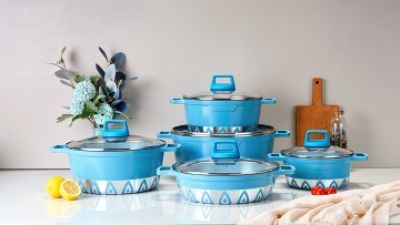
A universal aluminum ceramic cookware set can make everyday cooking more flexible and convenient. Designed for modern kitchens, this set combines lightweight aluminum construction with a ceramic nonstick surface, helping food release easily while making cleanup less demanding. The practical design supports a wide range of recipes, from quick breakfasts and sautéed vegetables to simmered sauces and family-sized meals.
At the core of the cookware is a flat, thickened magnetic conductive base, carefully engineered to provide stable heat distribution across different cooking surfaces. It is compatible with induction, electric, halogen, and gas stoves, allowing one coordinated set to serve kitchens with varying heat sources. This broad compatibility also makes it a useful choice for households that move between cooking methods or plan to update their appliances in the future.
Manufactured in China using advanced production techniques, the cookware is developed with daily performance and lasting use in mind. The balanced aluminum body supports responsive heating, while the reinforced base helps improve stability during cooking. With its versatile compatibility, nonstick ceramic interior, and durable construction, this cookware set offers a practical foundation for preparing a wide variety of meals.
: Check wall thickness, weight consistency, flat bases, smooth rims, and secure handles. Look closely. Bright light can reveal pinholes, dents, sharp edges, or exposed metal. Request production samples before ordering.
Ask for alloy information, food-contact documents, and recent laboratory reports. Testing claims should connect to recognized procedures. Keep all records with purchasing files.
Test at least three samples from separate batches when possible. Compare ten random units from a shipment. One perfect sample proves very little.
Fill a sample with water and lift it by both handles. Check bending, handle stability, lid fit, stacking, oven movement, and cleaning resistance. Commercial kitchens are harsh. My one-week test was not enough.
Request business registration, factory details, certificates, audit records, and production evidence. Ask about alloy grade, coating, wall thickness, handles, and heat limits. Contact former customers when possible. Polished claims can still disappoint.
Compare landed cost, not only the unit price. Separate tooling, packaging, inspection, freight, payment charges, and currency details. A cheap quote may hide thin walls or unstable coating. Freight can change.
Record approved measurements, materials, colors, labels, lid fit, defect limits, and replacement terms. Use dated photographs and batch numbers. This may slow purchasing. It can prevent expensive confusion.
Use separators or sleeves when nested surfaces may scratch. Confirm carton dimensions, pallet patterns, stack limits, and moisture protection. Store cartons on pallets, away from damp floors and sunlight. Inspect inner cartons after delivery, not just the outer pallet. Humidity remains a weakness in my plan.
Buying an Aluminum Casserole in bulk requires careful planning before placing an order. Start by defining your required quantity, capacity, shape, intended use, and budget. Compare aluminum grades, thicknesses, sizes, and cooking features to find products that provide suitable heat distribution and practical performance. Pay close attention to quality, food-contact safety standards, surface finishes, and durability, especially if the cookware will be used frequently or in commercial settings.
Next, evaluate suppliers by checking their experience, production capabilities, pricing, minimum order quantities, and sample policies. Discuss customization options, labeling, packaging strength, shipping schedules, and storage requirements to reduce damage and handling costs. Before confirming the purchase, review contracts, inspection procedures, warranty coverage, replacement policies, and after-sales support. Clear communication and written agreements can help ensure consistent product quality, predictable delivery, and a smoother bulk-buying experience.