DAFEIT
over 100,000 square meters
SPECIALIZED INTEGRATED MANUFACTURER

Leave Your Message
SPECIALIZED INTEGRATED MANUFACTURER
Finding the right supplier for aluminium non-stick pans isn’t just about plowing through factory prices, you know? It’s really about seeing the proof behind those numbers. I mean, did you know that Grand View Research pegged the global cookware market at around $19.3 billion in 2023? And it’s not stopping there — they’re expecting it to keep growing through 2030. That kind of growth naturally pulls in all sorts of manufacturers, some reliable, some not so much. So, as a buyer, it’s crucial to figure out who’s actually worth your trust.
Here’s a little tip — a good audit should dig into details like the alloy grade, the coating system, how thick the pan is, how the handle is fixed, and even the production controls. Don’t be shy to ask for material declarations, coating test reports, documents proving it’s safe for food contact, and traceability info on batches. And, if you can, request samples from different production lots. Sometimes, a pan might perform great at first — but after a few heats, it could fail. Pay close attention to areas like the base, rivets, rims, and edges of the coating — those small details can reveal big quality issues.
Lisa McManus, the Executive Tasting and Testing Editor over at America’s Test Kitchen, often reminds us that “nonstick cookware is not forever cookware.” Totally true, especially when you’re looking at a non-stick aluminium pan for retail or restaurant use. The key is to ask suppliers to give you a realistic idea of how long the coating should actually last — not some unrealistic promise of permanent durability. It’s smart to compare factory claims with independent test results from places like Intertek or SGS, but make sure those reports match the exact model and batch you’re considering.
Other good steps? Doing supplier audits, requesting production videos, and talking to their customers for references. But remember — no checklist is totally foolproof. A factory might look all shiny on the surface but be hiding weak process discipline behind the scenes. The smart move is to combine technical checks, some hands-on testing, clear and open communication, and a solid written agreement on quality. That way, you’re much more likely to end up with a reliable aluminium non-stick pan supplier — one who’s accountable and minimizes surprises that could cost you a lot in the long run.
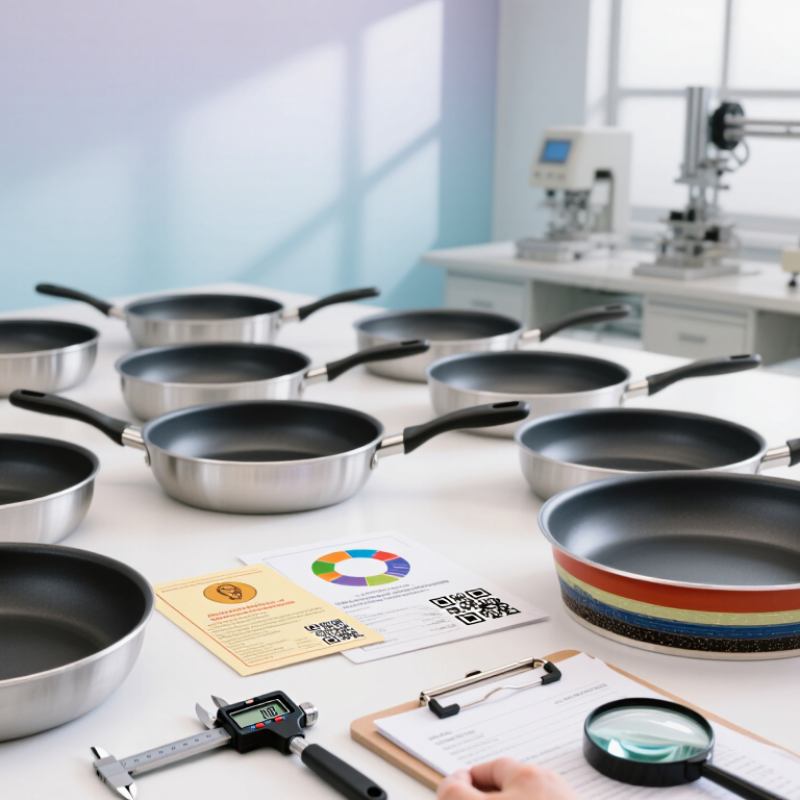
When sourcing an Aluminium Non Stick Pan, define the metal before discussing price. Pure aluminium has a density of approximately 2.70 g/cm³, according to NIST reference data. This figure helps verify material claims, although alloys and coatings can change the measured result. Ask suppliers to state the alloy grade, temper, sheet thickness, and forming process. Grades such as 3003 or 5052 may offer different balances of formability and strength. Do not accept “premium aluminium” as a complete specification.
Size must be measurable. Record the rim diameter, base diameter, wall height, handle length, and finished weight. A 28-centimeter pan may have a much smaller cooking base. That difference affects heat distribution and customer expectations. I would request drawings, tolerance ranges, and three sample measurements from separate production batches. Small variations often appear after deep drawing.
Industry scale also matters. The USGS Mineral Commodity Summaries 2024 reported about 70 million metric tons of primary aluminium production worldwide in 2023. The International Aluminium Institute states that recycled aluminium uses roughly 5% of the energy required for primary production. These figures support responsible material discussions, but they do not prove pan quality. Suppliers should provide alloy certificates, density or composition testing, coating thickness records, and flatness results. One weakness remains: laboratory data may not represent daily cooking. Test the pan with repeated heating, washing, and food release checks before approving a large order.
| Specification Dimension | Recommended Requirement | Typical Technical Data | Why It Matters When Selecting a Supplier | Verification Method |
|---|---|---|---|---|
| Pan body material | Food-contact aluminum alloy suitable for deep drawing or forming | Common cookware alloys include 3003 aluminum; alloy selection should match the forming process and required strength | The alloy affects formability, thermal response, corrosion resistance, and dimensional stability | Review the material certificate and perform alloy identification by XRF or equivalent laboratory testing |
| Aluminum grade | Specify the exact grade instead of using only the term “aluminum” | 3003 is widely used for formed cookware because of its good formability; 1050 or 1060 may be used where high ductility and conductivity are prioritized | A defined grade makes supplier quotations, quality checks, and replacement sourcing more consistent | Compare the purchase specification with the certificate of chemical composition and batch traceability records |
| Material density | Use density as a reference value, not as the only material-identification criterion | 2.70 g/cm³ is the commonly referenced density of pure aluminum at room temperature; alloy densities can vary slightly, for example approximately 2.73 g/cm³ for 3003 aluminum | Density supports weight and volume calculations, but it cannot alone confirm the exact alloy grade | Check calculated weight against measured weight and confirm the alloy using chemical composition testing |
| Pan diameter | Select the nominal diameter according to the target cooking capacity | Typical sizes: 20 cm, 24 cm, 26 cm, 28 cm, and 30 cm; the usable cooking surface is smaller than the outer rim diameter | A clear diameter definition prevents confusion between the outer rim, inner cooking surface, and base diameter | Measure at the specified reference point with a calibrated steel rule or vernier caliper |
| Pan depth | Define the vertical depth from the internal cooking surface to the rim | Typical frying-pan depth: approximately 4.0–6.5 cm, depending on diameter and product design | Depth influences cooking volume, splash control, packaging dimensions, and stacking efficiency | Inspect the approved drawing and measure samples using a height gauge or depth caliper |
| Aluminum body thickness | Set a minimum thickness for the sidewall and cooking base separately | A practical specification may use approximately 2.0–3.0 mm for the formed body, subject to design, diameter, and heating requirements | Thickness affects heat distribution, rigidity, deformation resistance, total weight, and production cost | Measure multiple points after removing or accounting for the coating system; record minimum and average values |
| Non-stick coating system | Specify coating type, number of layers, target dry-film thickness, and permitted food-contact use | Common systems include PTFE-based or ceramic sol-gel coatings; the actual coating thickness and layer structure depend on the approved formulation | Coating construction strongly affects release performance, abrasion resistance, and service life | Review the coating technical data sheet and conduct release, abrasion, adhesion, and food-contact compliance tests |
| Coating adhesion | No peeling, blistering, or visible delamination after the agreed test procedure | Cross-cut adhesion testing may be evaluated with reference to ISO 2409 or ASTM D3359, where applicable to the coating system | Poor adhesion can lead to early coating failure during cooking, cleaning, or thermal cycling | Use a documented cross-cut or equivalent adhesion test on production samples |
| Cooking-surface flatness | Define the maximum allowable concavity or convexity after forming and coating | The allowable value should be agreed on the engineering drawing; the pan should remain stable on the intended cooktop | Excessive warpage causes uneven heating, rocking, and reduced contact with the cooktop | Check on a certified flat surface with feeler gauges or a calibrated flatness fixture |
| Base compatibility | State whether the pan is intended for gas, electric, ceramic, or induction cooking | Bare aluminum is not inherently induction-compatible; induction models generally require a suitable magnetic stainless-steel plate or base structure | The heating method affects base construction, flatness, heating efficiency, and product labeling | Perform a cooktop compatibility test and verify the base construction against the approved drawing |
| Handle specification | Define handle material, fixing method, length, balance, and heat-resistance requirement | Common options include riveted or screwed metal handles and heat-resistant polymer handles; the final temperature limit must be confirmed by testing | Handle security and balance influence safe handling and user comfort | Conduct pull, torque, balance, and thermal-resistance tests according to the agreed product standard |
| Food-contact compliance | Require documentation for the finished pan, including coating and substrate where applicable | Applicable requirements depend on the destination market and may include limits for extractable substances, heavy metals, and coating constituents | Compliance must be assessed for the finished product rather than assumed from the aluminum grade alone | Request valid third-party laboratory reports, declarations of compliance, and batch-related traceability documents |
| Supplier quality documentation | Require an approved drawing, inspection plan, material certificate, coating data sheet, and pre-shipment inspection record | Documents should identify the specification revision, production batch, inspection date, measured results, and acceptance criteria | Document control reduces specification changes, inconsistent batches, and disputes over acceptance | Audit the document set and compare recorded results with independently inspected samples |
Technical reference note: Aluminum density is temperature- and composition-dependent. The value of 2.70 g/cm³ is a commonly used reference for pure aluminum at room temperature; the actual density of an aluminum alloy should be confirmed from the applicable material specification.
The base controls heat distribution, stability, and cooking response. Aluminium spreads heat quickly. Coating alone cannot fix a poorly designed base.
Aluminium conducts heat at about 205 W/m·K. This helps the pan respond quickly when the burner changes.
Compare flat, bonded, and encapsulated bases. Measure heating time, center temperature, edge temperature, and cooling response.
Yes, a magnetic steel plate can support induction cooking. Poor bonding may create hot rings around the center.
Not always. A thicker base stores more heat but may respond slowly during delicate cooking.
Request cross-section samples, bond-strength records, thermal maps, and repeated heating-cycle results. Numbers alone are insufficient.
Check certification scope, expiry dates, and the actual production site. Compare written procedures with shop-floor practices.
Review aluminium thickness, coating batches, curing temperatures, handle inspections, and corrective action reports.
Match alloy records, batch numbers, carton labels, and shipment documents. Missing records may create costly delays later.
Check rejected pans, storage areas, calibration labels, and inspection files. Clean displays can still hide weak habits.
Finding the right Aluminium Non Stick Pan supplier in China requires a structured evaluation rather than a focus on price alone. Begin by defining the product specifications, including aluminum grade, approximate density of 2.70 g/cm³, dimensions, wall thickness, and handle requirements. Review the nonstick coating documentation for alignment with FDA 21 CFR 175.300 and EU Regulation 1935/2004, then compare base designs according to aluminum’s approximately 205 W/m·K thermal conductivity and the intended cooking performance.
A reliable supplier should provide ISO 9001 evidence, traceable raw-material records, standardized production procedures, and batch inspection reports. Request performance verification, including PTFE testing at up to 260°C where applicable, coating adhesion checks, and durability testing over 5,000 cycles. Finally, assess MOQ, tooling charges, lead time, certifications, packaging, shipping, and total landed cost. The best choice is the supplier that combines consistent quality, transparent documentation, stable production capacity, and dependable inspection controls.