DAFEIT
over 100,000 square meters
SPECIALIZED INTEGRATED MANUFACTURER

Leave Your Message
SPECIALIZED INTEGRATED MANUFACTURER
Designed to withstand the continuous heat cycles of commercial kitchens and training academies.
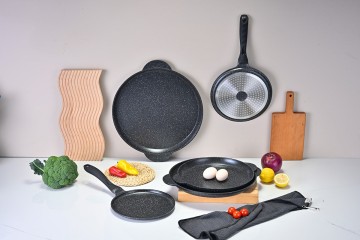
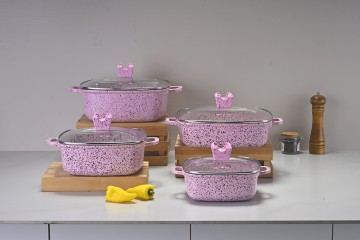
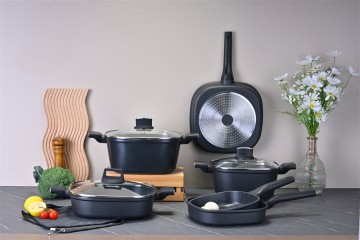
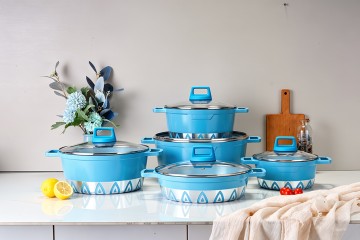
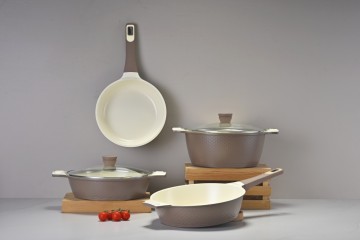
Prioritizing user safety and intimate experience, our aluminum ceramic nonstick cookware set in commercial grade configuration.
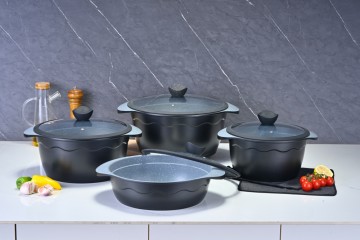
Blending exquisite modern aesthetics with professional cooking performance, our aluminum ceramic collection sets the industry standard.
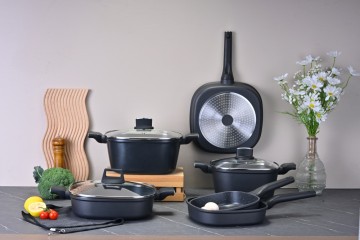
Expanded multi-ply base technology designed for rapid thermal response and heavy-duty use in professional culinary lessons.
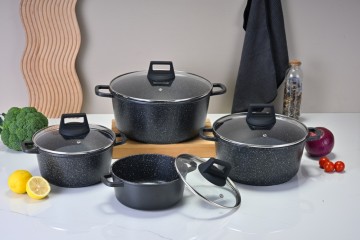
Upgrade your daily cooking routine with our premium aluminum ceramic nonstick cookware set, engineered for culinary academies.
Historically, professional kitchens, Michelin-starred establishments, and culinary training facilities relied almost exclusively on raw cast iron, carbon steel, and heavy-gauge stainless steel. While these materials offer unmatched longevity, they present significant challenges in modern culinary workflows: they require complex seasoning, demand high fat/oil usage, and are prone to scorching delicate items.
Today, the commercial hospitality sector is witnessing a massive transition. High-performance, professional-grade nonstick pots and pans are no longer viewed merely as consumer-grade conveniences. Instead, they have become essential tools for precision cooking. Modern nonstick coatings, particularly advanced ceramic matrices and diamond-reinforced layers, offer the thermal conductivity required for gourmet results while significantly streamlining kitchen operations.
The demand for professional-grade nonstick pots in culinary schools and catering operations is governed by strict parameters. Unlike home cookware, which may only see a few hours of use per week, a commercial nonstick pot is subjected to continuous thermal shock, metal utensil contact, and chemical dishwashing agents.
To meet these industrial demands, manufacturers utilize multi-ply clad structures. The core of these pots is typically constructed from heavy-gauge aluminum or copper, which ensures rapid heat distribution. This core is then wrapped in layers of stainless steel to provide structural integrity and induction compatibility. The nonstick surface itself is engineered using advanced chemical deposition techniques.
Safety and Regulatory Compliance: Modern commercial kitchens must adhere strictly to food safety regulations. Leading nonstick solutions are completely free of PFOA, PFOS, Lead, and Cadmium. The transition toward inert ceramic coatings (silicon dioxide-based) ensures that even under high heat, no toxic fumes or chemical residues leach into the food, satisfying both FDA (Food and Drug Administration) and EFSA (European Food Safety Authority) standards.
"By utilizing ceramic-reinforced nonstick pots, our students can master delicate emulsion sauces like Hollandaise and Béarnaise without the constant fear of scorching. This shifts the educational focus from cleanup and damage control to flavor profile development and plating artistry."
— Director of Culinary Curriculum
Culinary academies are unique environments where cookware is subjected to a wide range of skill levels. Students learning the basics of heat management frequently overheat pans or use incorrect utensils. Therefore, the cookware must be exceptionally forgiving.
1. Mastering Delicate Emulsions and Sauces: Classical French cuisine requires precise control when executing roux, reductions, and egg-based emulsions. Traditional copper pots, while responsive, require constant vigilance. Ceramic nonstick pots provide a buffer, distributing heat evenly across the base and up the sides, preventing localized scorching.
2. Sugar Work and Confectionery Training: Pastry arts demand exact temperatures. Melting sugar or tempering chocolate in a nonstick environment prevents sticking at the margins, ensuring clean transfers and reducing product waste during practical exams.
In the catering sector, efficiency is synonymous with profitability. Caterers operate in high-pressure environments—preparing banquets for hundreds of guests, often in mobile kitchens or off-site venues with limited utility access.
Rapid Turnaround and Labor Reduction: In high-volume catering, the dishwashing station is often the bottleneck. Traditional pots with baked-on proteins require soaking, scrubbing, and extensive labor. A premium nonstick pot can be wiped clean and sanitized in seconds, allowing the kitchen staff to reuse the same vessel for multiple courses during a single service. This drastically reduces the total volume of cookware a catering company needs to transport to off-site events.
Holding and Buffet Presentation: Catering services frequently require keeping food warm for extended periods. Nonstick pots designed with magnetic induction bases can transition seamlessly from the prep kitchen to the front-of-house induction buffet line. The nonstick layer prevents the bottom layer of food from drying out, burning, or sticking to the vessel during long holding times, maintaining the visual appeal and taste of the dish.
The commercial kitchen of tomorrow is highly connected and deeply focused on sustainability. Cookware manufacturers are now developing smart nonstick pots integrated with RFID tags and thermal sensors. These sensors communicate directly with commercial induction cooktops, automatically regulating temperature to prevent overheating—the number one cause of nonstick coating degradation.
Furthermore, the industry is moving rapidly toward circular economy principles. Leading manufacturers are offering recoating programs for commercial clients, allowing culinary schools and caterers to send back worn pots to be sandblasted and recoated rather than discarded. This dramatically reduces the carbon footprint and capital expenditure of large culinary institutions.
Procurement managers in culinary schools and catering corporations must look beyond the initial purchase price of cookware. A cheap pot that needs replacement every six months is far more expensive than a premium, commercially-rated nonstick pot that performs reliably for two to three years.
By investing in high-quality aluminum ceramic nonstick cookware, businesses benefit from lower energy bills (due to faster heat transfer), reduced water and chemical detergent consumption, and significantly lower food waste. When students and chefs work with tools that distribute heat predictably, the rate of ruined dishes drops, directly boosting the bottom line.
Premium nonstick solutions engineered for culinary schools, banquets, and commercial catering events.